Outline
1. Introduction to networking and the OSI reference model and TCP/IP [1.0H]
Introduction to data networks and data communications basics
Application types and requirements
The OSI-RM functions, and the modular structure of the data network with it's Relation the
systems.
The TCP/IP architecture and protocols
2. The Ethernet protocols and LAN switching [1.0H [
The Ethernet protocols
Page 2 of 2
10M/100M to 200/400G Ethernet
Frame structure
LAN switching operation and technology
Unicast, Multicast, Broadcast and Anycast
VLANs (Virtual LANs) technology and VLAN tagging (802.1q)
3. IPv4 – Protocol and Addressing [1.0H]
IPv4 characteristics and packet structure
ARP – Address Resolution Protocol
IPv4 addressing, address classes
VLSM and CIDR (brief)
Tunneling protocols – GRE and IPIP
Multicast and IGMP
4. IPv6 – Protocol and Addressing [0.5H]
IPv6 characteristics and packet structure
IPv6 addressing and address types
5. Layer 4 Protocols – TCP and UDP [1.0H]
L4 operations, ports and sockets
Connectivity and reliability
Well known ports
UDP Basics and frame structure
UDP operation
TCP frame structure, The TCP connectivity and reliability, the sliding window mechanism.
6. IP Routing Principles [0.5H]
Switching vs. routing
Routing principles
Static and dynamic routing
7. Carrier Ethernet (brief) [1.0H]
Introduction and operation principles
Network architecture, structure and protocols (NNIs, UNIs, Demarcations points…)
Service structure (EVC types, service attributes)
8. Multi-Protocol Label Switching (MPLS) (brief) [1.0H]
Introduction and operation principles
VPNs and VPN types
9. 5G Cellular Networks (brief) [1.0H]
Introduction, network structure and components
Page 3 of 2
Network protocols (PHI, MAAC, RLC, PDCP, SDAP)
Data Radio Bearers (DRBs) and QoS Flow Identifiers (QFIs) and mapping to GTP
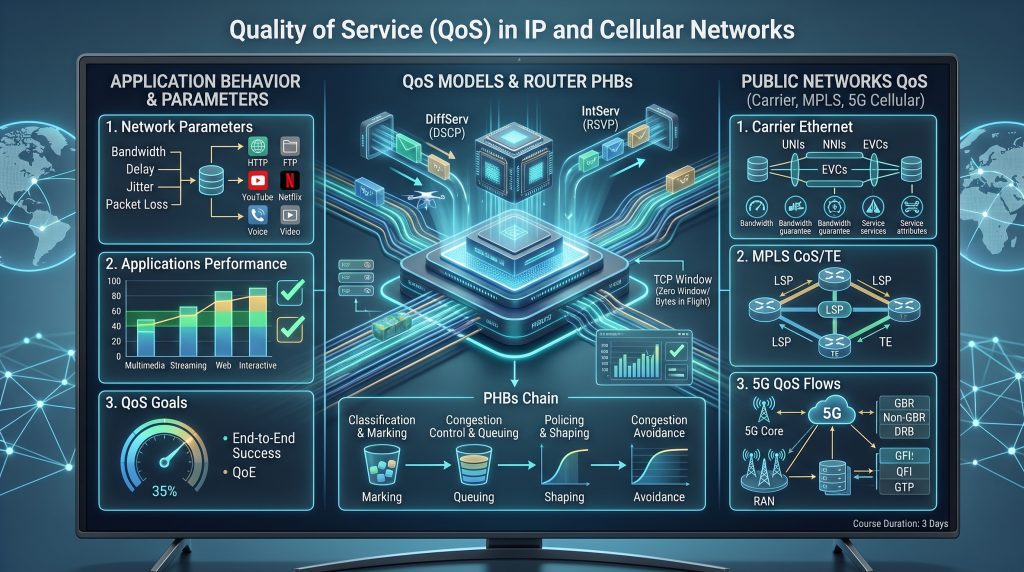
10. Applications behaviours over data networks [2.0H]
Network parameters – Bandwidth/Thoroughput, Delay, Jitter, Packet loss
Causes for network resources shortage
Case studies and examples (.pcaps)
Transfer-based applications (HTTP, FTP, Mail..) over IP networks
Interactive applications (databases, RPC..) over IP networks
Streaming and gaming (Netflix, Youtube..) over IP networks
Multimedia applications (Voice/video) over IP networks
11. QoS in communications networks [1.0H]
QoS over the transmission chain (User-Access-Core) networks
Definitions – QoS, QoE, End-to-End QoS and more
Standards and standardization structure and implementation
o ITU-T standards (E.800, E.804, G.1000..)
o ETSI standards (Speech and Multimedia QoS)
o IETF standards (DIffServ, IntSErv and PHBs)
o 3GPP standardization
How it all fits together (what is practical ad what is not)
12. The QoS model and protocols (4.0H)
L2 Class of Service (CoS)
Differentiated services (DiffServ)
o Data structure (the ToS byte)
o DSCP values
o Traffic classification
o CoS to DiffServ mapping
Integrated Services and RSVP
o the RSVP protocol and operation
Proprietary applications (Cisco NBAR, Juniper Application Recognition)
Configurations examples brief (Cisco, Ericson)
13. Routers behaviour under QoS conditions (PHBs) [4.0H]
The QoS chains and packets delivery
Classification and marking
Congestion control ad queuing mechanisms
Policing ad shaping
Page 4 of 2
Congestion avoidance mechanisms
14. MPLS QoS – standards and implementations [1.0H]
MPLS Traffic Engineering (TE)
MPLS CoS/QoS enforcement
15. Carrier Ethernet QoS – standards and implementation [1.0H]
Carrier Ethernet network structure overview
QoS enforcement in Carrier Ethernet EVCs
16. 5G Cellular Networks QoS [2.0H]
5G network structure overview
Bearers, Flow types and Service data Flows (SDFs), QoS Flow Identifier (QFI)
QoS Profiles, GBR and Non-GBR flows
Note: course content might have minor changes after preparation prior to the course. Updated syllabus
will be sent with materials prior to the course.
Timetable
Day Chapt
er
Subject Hours
Day 1
1 Introduction to networking, the OSI reference model and TCP/IP 1.00
2 The Ethernet protocols and LAN switching 1.00
3 IPv4 – Protocol and Addressing 1.00
4 IPv6 – Protocol and Addressing 0.50
5 Layer 4 Protocols – TCP and UDP 1.00
6 IP Routing Principles 0.50
7 Carrier Ethernet (brief) 1.00
8 MPLS (brief) 1.00
9 5G cellular networks (brief) 1.00
Day 2-
3
10 Applications behavior over data networks 2.00
11 QoS in communications networks 2.00
12 The QoS model and protocols 4.00
13 Routers behaviour under QoS conditions 4.00
14 MPLS QoS – standards and implementations 1.00
15 Carrier Ethernet QoS – standards and implementation 1.00
16 5G Cellular Networks QoS 2.00
Total 24.00